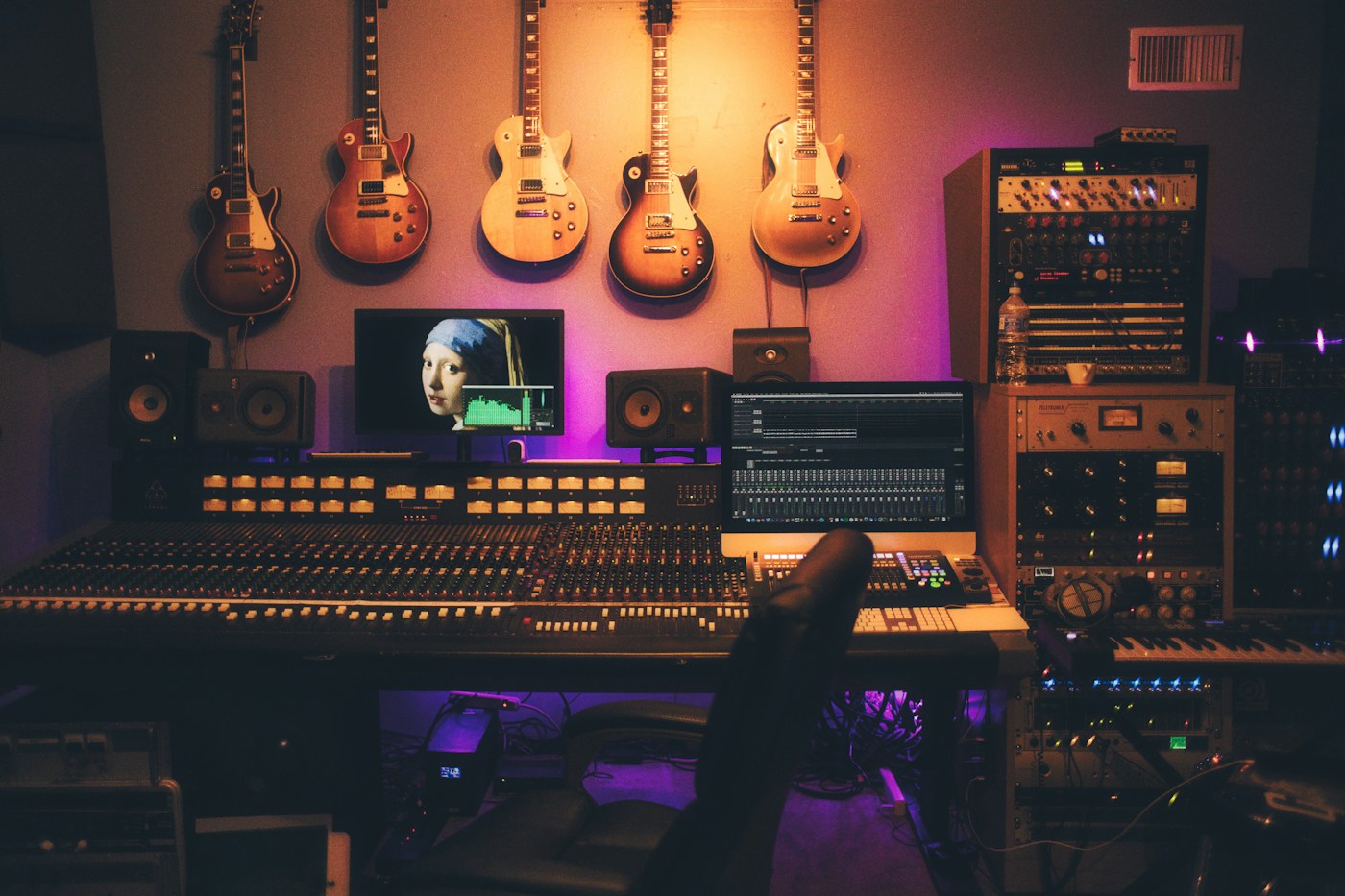
Ray Kowalski has been making music his whole life. He grew up with music in the house, started playing in his teens, never really stopped. He served in the Navy. He taught school for over thirty years. Through all of it — the deployments, the lesson plans, the parent conferences, the retirement — music was the constant. And for most of those decades, so was the home studio.
He'd built it up slowly. A decent interface. A good condenser mic. Monitors he'd researched carefully. Software he'd learned version by version through the years when DAWs were new and forums were the only source of answers. By the time he retired from teaching, Ray had a real setup. Acoustic panels on the walls. A proper desk. A room that, on a good day, sounded like something.
What he didn't have was music that sounded professional. Not consistently. Not in the way he could hear it needed to.
He was working on an album of acoustic originals with a fellow songwriter — the kind of record two people make when they've been talking about it for years and finally decide to just do it. He performed live at least once a month. He knew what good recordings sounded like. He just couldn't quite get there himself.
"The gap between what I was hearing in my head and what was coming out of the speakers," Ray says, "that gap had been there for a long time. I thought it was the room. Then I thought it was the gear. Eventually I started to think it might just be me."
It wasn't him. It was the framework — or rather, the absence of one.
Decades of Experience, Missing One Thing
The frustrating thing about home recording — and Ray will tell you this himself — is that experience doesn't automatically compound into skill. You can spend twenty years making records at home and still make the same foundational mistakes, because nobody ever sat down and corrected them. You can watch tutorials indefinitely and still not know the right order to do things in.
That's not a talent problem. It's an information problem.
What Ray was missing wasn't more time at the desk, or better plugins, or a bigger room. What he was missing was a structured, sequential framework for what to do and in what order — from the moment he opened the session to the moment the final master hit his hard drive.
Having the tools is not the same as having the process.
Most self-producing artists who plateau at a semi-professional level aren't held back by gear or talent. They're held back by the absence of a repeatable process. Pro engineers don't reinvent the wheel every session — they follow a framework refined over thousands of hours. That framework is rarely written down, rarely taught, and almost never explained in YouTube tutorials. The Mixing & Mastering Cheat Sheet Binder from Mastering.com is the closest thing to it most home producers will ever hold in their hands.
When a friend pointed Ray toward the Mixing & Mastering Cheat Sheet Binder from Mastering.com — thirty pages of structured reference covering EQ, compression, the complete mixing workflow, gain staging, mastering steps, vocal processing, and more — he was skeptical in the way that only someone who has tried everything else can be skeptical.
He ordered it anyway.
The Car Test: When Everything Clicks
There's a test every mixing and mastering engineer knows about, usually learned the hard way. You finish a master in the studio, it sounds perfect on the monitors, then you get in the car and it falls apart. The low end is wrong. The vocals are too forward. Something perfectly balanced in the room is broken on the stereo.
For most home producers, the car test is a source of ongoing anxiety and abandoned mixes. It's the symptom of not having a proper mastering process — specifically, of not checking your work against commercial loudness targets and frequency balance standards before calling it done.
About two weeks after Ray started working with the binder, something happened that had never happened to him before in decades of home recording.
"It just sunk in today when listening to a master in the car that it sounds exactly the same as in the studio."
Ray KowalskiThe reason his masters finally translated was a page in the binder called Foundation First - a step-by-step framework for building the low-end backbone of a mix before anything else gets added. It covers gain staging the kick and bass to precise dBFS targets, calibrating metering tools for your genre, and running a limiter stress test to confirm the foundation holds at commercial loudness. Once that foundation is right, the rest of the mix sits on top of it correctly - and more importantly, stays correct when played back anywhere. Ray had been skipping this step, not because he was careless, but because nobody had ever laid it out as a sequence he could follow.
When your master sounds the same in the car as it does on the monitors, you've crossed a threshold. You're not guessing anymore. You're engineering.
Then Came the Radio
What happened next is the part of Ray's story that surprises people. Because most people, when they imagine a retired teacher mastering his own acoustic records at home for the first time, don't imagine what came next.
PBS Public Radio. A song he performed, recorded, mixed, and mastered himself. Playing on the air. It didn't stop there.
WYCE 88.1 FM. Three hundred miles from the room where it was made. Recorded, produced, mixed, and mastered entirely in the box — by someone who, a year before, couldn't get his masters to translate to the car.
Essen, Germany. A live indie radio station. Two days of airplay. For a record made by a retired schoolteacher in a home studio.
Then He Started Getting Clients
The radio play was never the goal. Ray had always just wanted to finish the record properly. But something about the consistency of his results started attracting attention from other musicians in his area.
He landed his first paying mastering client in December 2022 - the same month he completed his own first master. By early 2024, he had been commissioned to record, mix, and master a full CD for a local band. He hadn't advertised. He hadn't pitched anyone. People had simply heard his work and asked.
Ray didn't set out to become a freelance engineer. He set out to finish his album. But when you develop the skill to make records that hold up, people notice - and in music, people who notice tend to ask.
Best known as an online audio school - now distilling a decade of 1-on-1 insight into print.
Mastering.com built its reputation as the worlds biggest online audio school, working directly with thousands of self-producing artists through intensive 1-on-1 mentorship. Over years of those sessions, the same gaps kept surfacing - not in talent or gear, but in process. The Mixing & Mastering Cheat Sheet Binder is the result: a decade of watching what actually stops home producers from sounding professional, distilled into a single physical reference you can keep on your desk.
What the Binder Actually Did
When you lay out Ray's timeline — November 2022 to early 2024, about fourteen months — the arc is almost hard to believe. From "struggling to sound professional despite decades of home recording" to radio plays on two continents and inbound clients for full record production.
Ray already had the ear. He'd been listening carefully to music his whole life. He could hear when something was wrong. What he couldn't do was identify why it was wrong or what to do about it in a systematic way.
The binder gave him the what and the why on the same page. Not a 47-minute tutorial he'd have to scrub through when he needed to remember something. A single page on the desk, open when he needed it, with the process written in plain terms he could follow in real time.
Twelve steps to organize a session. Four ways to use an EQ. Three ways to use a compressor. A vocal mixing formula. A frequency balance chart. Every decision he'd previously made by intuition or guesswork, now made by framework.
"I had been recording for decades. The binder didn't teach me to hear better. It taught me what to do with what I was already hearing."
Ray Kowalski"I remember struggling and wondering how I was going to finish this project with the knowledge I had at the time. The binder was the lifeline I needed."
Ray Kowalski · Retired teacher, Navy veteran, recording artist